
I am a Forest School teacher and I run workshops for children outdoors, in and around Cluj-Napoca. Parents tell me the same thing in different words every autumn: the child would love it, the child is not allowed to get there alone.
That sentence is a design outcome, not a parenting decision. And there is a piece of urban policy addressing it that costs almost nothing and keeps turning up in European cities under different names.
What a school street is
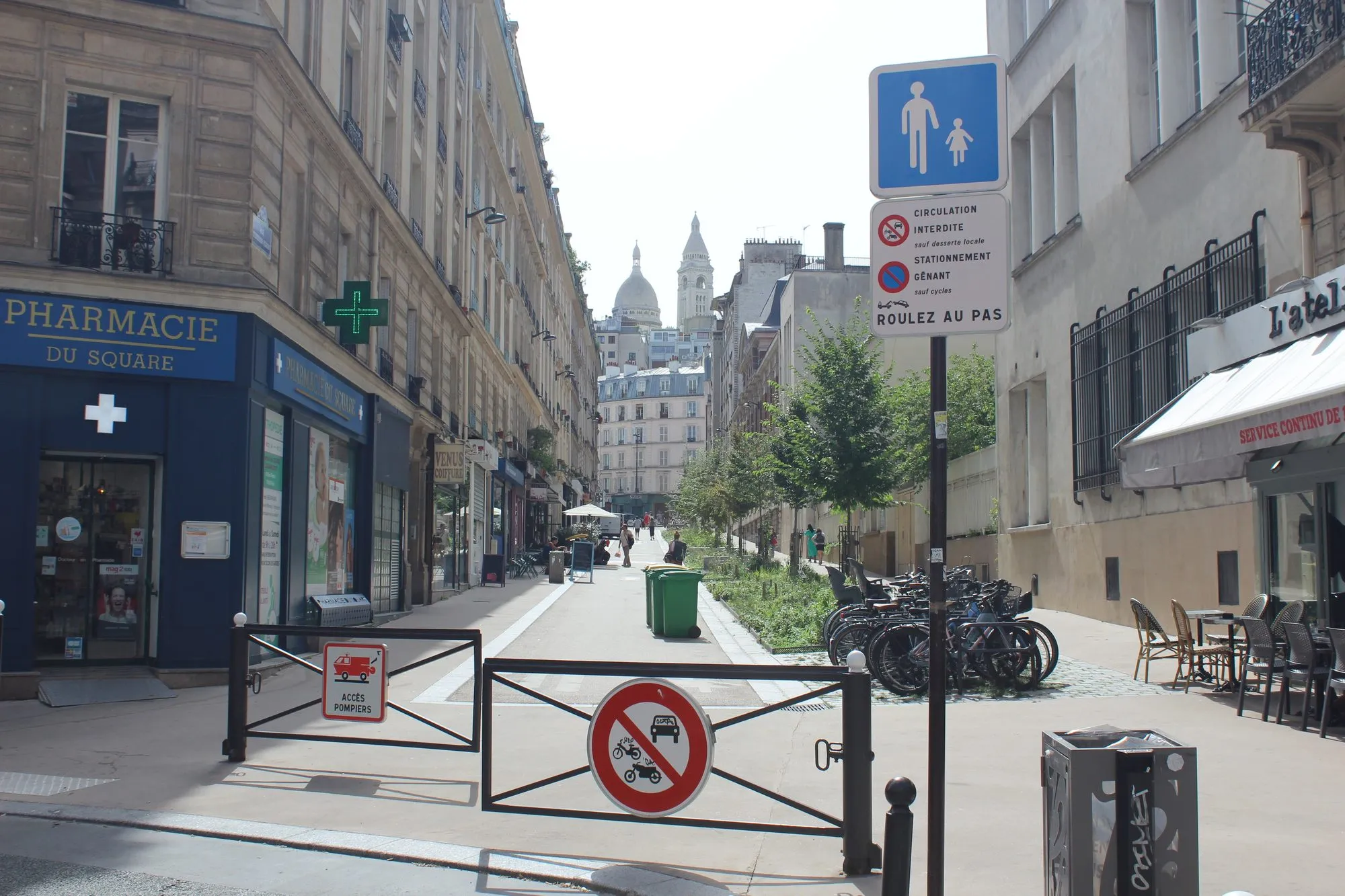
A street next to a school closes to through traffic at drop-off and pick-up. Not permanently, not for everyone — residents, deliveries and blue badges usually keep access. For roughly forty minutes twice a day, the road outside the gate stops being a car park with a school attached.
There is no new building. There are bollards, a sign, sometimes a camera, often a parent volunteer in a high-visibility vest.
The scale it has reached
Paris is working towards 300 school streets by 2026, with more than 230 already in place, and many rebuilt with planting rather than just barriers. That programme is a large part of why the Clean Cities Campaign ranked Paris first in Europe for child-friendly mobility in its 2025 assessment.
London has school streets at more than 500 locations, restricting traffic at the start and end of the school day.
Oslo calls them heart zones — hjertesone. 82 of the city’s 314 primary schools now have streets that are either temporarily closed to through-traffic or permanently pedestrianised.
The Clean Cities ranking also makes a point that matters more than the league table: children report feeling safe on cycle routes that are physically separated from traffic, and Paris and Helsinki have protected networks covering close to half their road length. Painted lines are not the same intervention.
Why I think this belongs on a site about urban innovation
Most of what gets filed under innovation on a city’s website involves a platform, a sensor or a pilot. This involves a bollard.
But look at what it changes. A child who can walk or cycle to school makes several hundred independent journeys a year. Those journeys are how a person learns their own city — which way the streets run, who is on them, what to do when something is unexpected. A child driven door to door learns a route through a windscreen.
It is also the rare measure with an immediate constituency. The people who benefit are standing at the gate every morning at the same time, and they know each other. In city after city, school streets have been the thing that gets residents involved in street design at all — and once a neighbourhood has successfully changed forty minutes of one street, it starts asking about the rest.
For Cluj, this is not an exotic import. It needs a school, a street, a defined time window and someone willing to enforce it. The most expensive part is deciding to do it.