
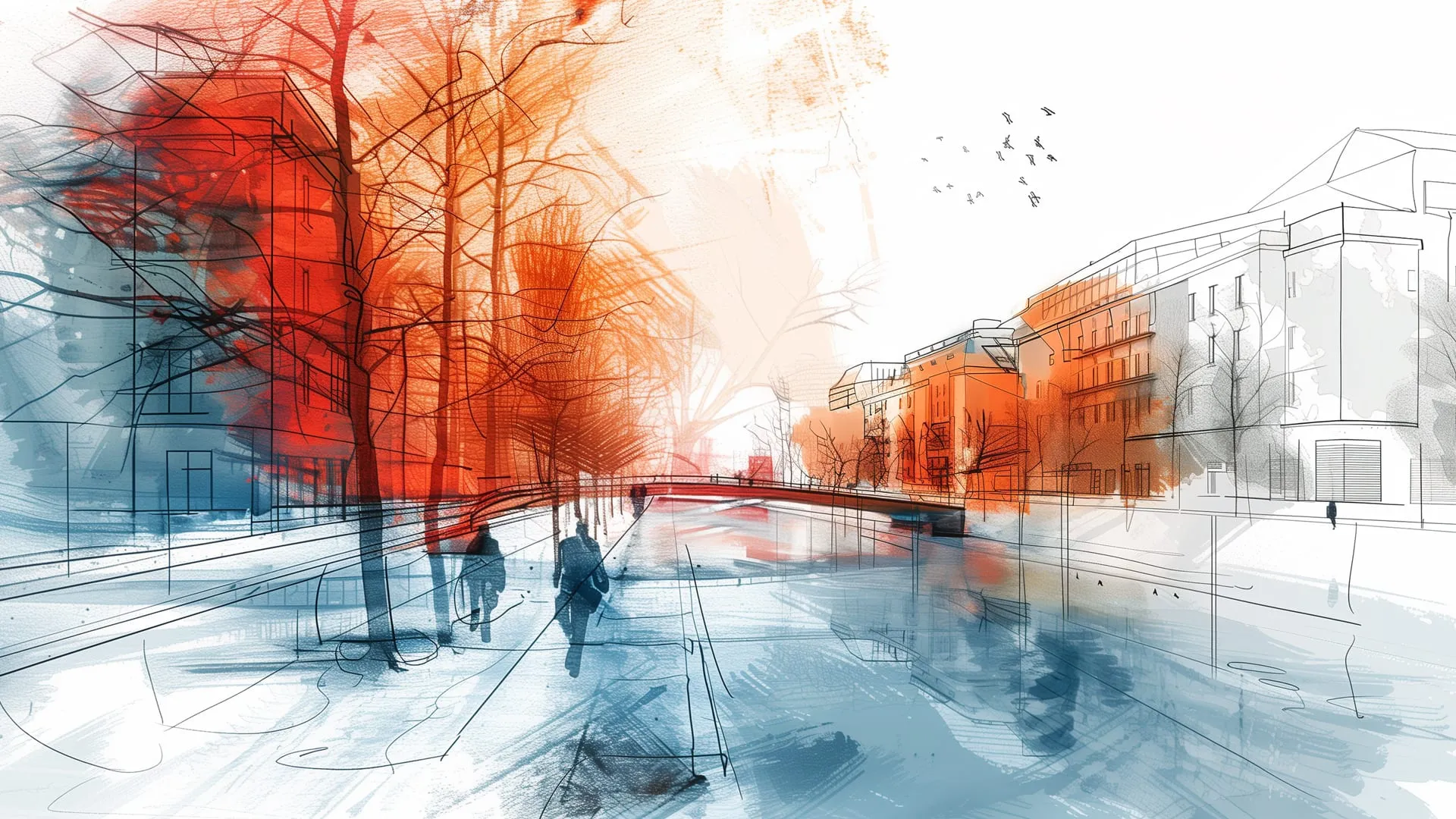
Cluj-Napoca spent most of the twentieth century with its back to the Someșul Mic. The river was infrastructure: something to drain into, build away from and cross quickly. The phrase the city now uses for the change — reîntoarcerea orașului cu fața la râu, turning the city back to face the river — is a fair description of what has to be undone.
Where it started
In 2017 the municipality ran an international solutions competition with the Order of Architects of Romania, asking for a vision that treated the Someș as a natural axis running through the city rather than a boundary between halves of it. That competition is what "Rethinking Someș" names. What followed is a construction project, and it is worth separating the two.
What is actually being built
The works run along Lunca Someșului Mic and cover 146,500 square metres, paid for with European money through the Regional Operational Programme 2014–2020. They add:
- 13,000 square metres of new green space, and 1,000 trees — 957 of them already in the ground by April 2023;
- promenade and leisure areas along both banks, with shared space where pedestrians, cyclists and vehicles share the surface rather than being separated by kerbs;
- cycle routes and pedestrian zones;
- a new bridge for pedestrians and cyclists.
Construction had reached about 70 per cent by April 2023. That is the most recent figure we can source, and it is the one that matters most for anyone reading a description of this project: it is being built, not finished.
The other half of the riverfront
Running alongside it is a separate and larger scheme. RIVUS, a masterplan by UNStudio, redevelops a former industrial site on the riverfront into a mixed-use district oriented to the water. Its zonal urban plan was approved in 2025; demolition and excavation are under way, with some industrial structures kept and restored; and it received its building permit in March 2026.
The two are easy to confuse and should not be. One is a public riverside landscape funded by the EU. The other is a development on land beside it. A city can do the first well and still get the second wrong, and the honest way to follow Cluj's riverfront is to watch them separately.
What to watch
Riverside schemes tend to be judged on the photographs taken the week they open. The questions that decide whether this one worked are slower ones: whether the promenade connects to the neighbourhoods behind it or only runs along the water; whether the new bridge lands somewhere people already want to go; whether the 1,000 trees are still alive in ten years; and whether the shared-space sections end up shared or simply become roads with better paving.
Figures from Monitorul de Cluj's reporting on the project, May 2023, which gives the 146,500 m², the 13,000 m² of green space, the 1,000 trees, the 957 planted by April 2023 and the 70% completion figure; the 2017 competition with the Order of Architects of Romania; and, for RIVUS, UNStudio's masterplan, its 2025 zonal urban plan approval and its March 2026 building permit. Rewritten and re-sourced in September 2026: the 2024 version of this page described the project as near completion and its riverbanks as already hosting festivals, and left five of its section headings empty.


